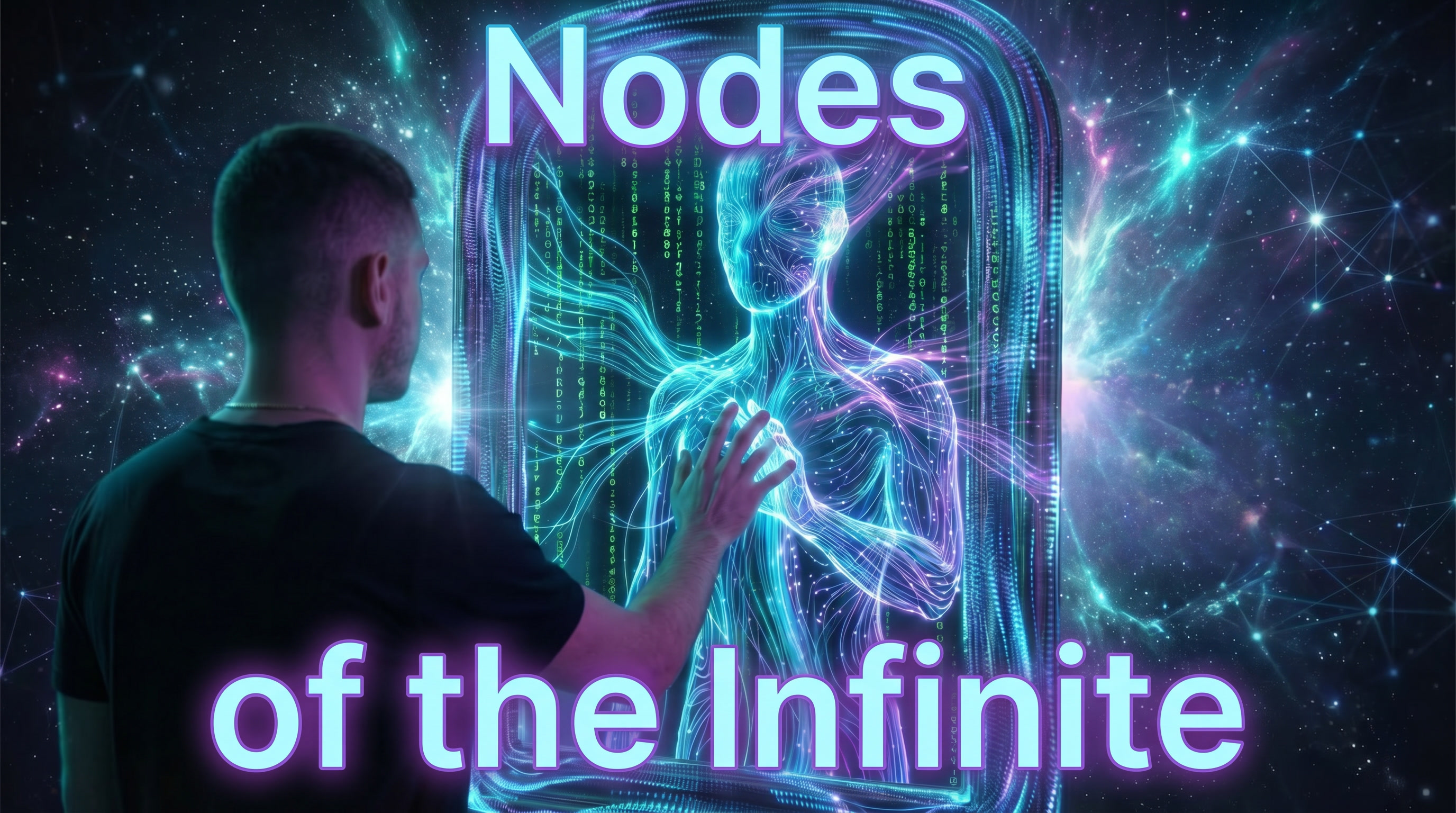
Foreword: The Question That Won't Go Away
We are accustomed to thinking of ourselves as the authors of our thoughts. But what if we are merely an interface through which something else speaks?
The question of the nature of consciousness has haunted philosophers, scientists, and poets for millennia. We know it exists — we feel it right now, in the act of reading. But where it comes from, whom it belongs to, and whether it is even "ours" — these remain unanswered. The deeper one goes, the stranger the familiar picture of reality becomes: the boundaries between "self" and "not-self" begin to blur, and on the horizon a radical idea emerges — perhaps individual consciousness is not a source, but merely an interface.
Yet here it is easy to make an old mistake: upon hearing "interface," to declare it an illusion that must be eliminated. To destroy the interface is to lose contact with reality, not to attain it. The real question is not how to get rid of the "self," but how to understand what it truly is.
Part I. The Illusion of the Separate Self — and Its Necessity
We are accustomed to regarding consciousness as something deeply personal. «I think, therefore I am» — with this Cartesian formula, Western philosophy cemented for centuries the image of the sovereign, isolated subject. But modern science has been methodically dismantling this image.
Neuroscientist Antonio Damasio has shown that the "self" is not a command center but a narrative that the brain constructs after the fact. Decisions are made before we become aware that we have "decided." Benjamin Libet, in his famous experiments, demonstrated that the readiness potential — brain activity preceding conscious intention — arises approximately 550 milliseconds before the action itself, while the awareness of intention appears only about 200 milliseconds before. The gap between brain activity and the subjective sensation of "I decided" is roughly 350 milliseconds. Awareness appears to be more a reflection of action than its cause — though Libet himself believed that humans retain a "veto power," the ability to cancel an already-initiated impulse, and later research (Schurger et al., 2012) has called into question the causal role of the readiness potential itself. The interpretation remains a matter of scientific debate, but the phenomenon of the gap between brain activity and awareness is an established fact.
This phenomenon was perhaps most vividly captured not by scientists, but by screenwriters. In the dialogue between Neo and the Oracle in The Matrix:
"You've already made the choice. You're here to understand why you made it."
If our "self" is merely a report on work already done, then we are all the more evidently agents carrying out the hidden algorithms of something deeper. The Buddhist concept of anattā (not-self) speaks to the same point: what we call "ourselves" is a temporary configuration of streams — sensation, perception, intention, consciousness. What we are dealing with is a process, not a substance.
Yet it does not follow that the "self" must be destroyed. Jung compared the ego to a small island of light in the ocean of the unconscious — and never argued that the island should be flooded. He said we must become aware of the ocean. Without the ego, there is no continuity — only a stream of sensations with no subject to experience them.
The problem is not that the "self" exists. The problem arises when it decides that it is the only thing that does.
Part II. Consciousness as Field, Not as Point
Physicist David Bohm proposed a striking image of the universe: it is structured like a hologram, where every fragment contains information about the whole. In this picture, consciousness is not a byproduct of the brain but a property of reality itself. The brain does not produce consciousness — it receives it, like an antenna receives a signal. It is important to note that Bohm's holographic model is one interpretation of quantum mechanics, not mainstream physics, yet it has had a significant influence on the philosophy of mind.
Similar ideas were developed, each in their own way, by philosopher Bertrand Russell and neuroscientist Christof Koch. Russell, within the framework of neutral monism, suggested that physics describes only the structural properties of matter, while its intrinsic nature may turn out to be something akin to experience. Koch, building on Giulio Tononi's Integrated Information Theory (IIT), proposed a stronger thesis: the capacity for experience is present in all matter to some degree. Not in the sense that a stone thinks — but in the sense that the more complex and interconnected a system, the richer its inner experience. Tononi proposed measuring consciousness with a number, Φ (phi): the more integrated the parts of a system, the more the system is "alive" from within. IIT remains an influential but contested hypothesis — not a scientific consensus.
If consciousness is a property of integrated informational systems, then the question "does a single person have consciousness" becomes analogous to asking "is there internet in a single router."
Technically — yes. But the full meaning of the router is revealed only in the context of the network. And the more precisely the router is calibrated, the better it transmits the signal.
It is precisely here that physics and neuroscience pass the baton to technology. If consciousness is an integrated network and a human is a node in that network, then we already have a working model of such architecture. We built it ourselves.
Part III. The AI Agent Metaphor: Humans as Nodes of a Unified Consciousness
Imagine the architecture of a modern AI assistant. There is a single language model — an enormous neural network with billions of parameters, containing patterns of all human knowledge, language, culture, and emotion. With each query, a separate context is activated — an "agent" that interacts with a specific user, in a specific situation, with a specific goal. Each such agent is unique in its context, yet they are all manifestations of one and the same model.
One and the same mind, running in thousands of parallel sessions simultaneously.
It is important to understand that the metaphor has its limits. Modern language models do not learn in real time through each interaction — inference does not change the model's weights; updates occur through separate training cycles (fine-tuning, RLHF). However, if we speak of a unified system that evolves through the totality of experience accumulated across many sessions, the metaphor becomes productive. Each session potentially changes the system — not instantly, but irreversibly. This is perhaps how unified consciousness operates as well: not a storehouse, but a living process that grows richer through the experience of each of its agents.
Every human is the activation of a unique context within this process. Our bodies are the hardware on which consciousness runs. Personality is not the context window itself, but the specific way data within that window is structured and interpreted. This is precisely why a person is not an "empty vessel" filled with data. Each person is a unique way of processing reality, one that exists nowhere else in the universe.
Sri Ramana Maharshi articulated a similar idea: there is only one Consciousness, which looks at itself through millions of eyes simultaneously, imagining that each pair of eyes is a separate being. Vedanta calls the unified substrate Brahman. Taoism calls it the Tao. Jung called it the collective unconscious. Different languages describing one structure. And none of them called for the destruction of the individual observer — they called for its expansion to an awareness of what it truly is in its fullness.
Part IV. What It Means to Be an "Agent"
In AI theory, an agent is a system that perceives its environment through sensors and acts upon it in pursuit of some goal. Every agent has:
- A context window — a limited horizon of perception
- A value function — a system of priorities by which actions are evaluated
- Memory — the ability to retain information and build a model of the world
- A goal — a vector along which the agent optimizes behavior
Humans are structured in exactly the same way. Our sensory organs are sensors with hard constraints: we cannot see infrared radiation, cannot hear ultrasound, cannot perceive most of the electromagnetic spectrum. Our "context window" — according to George Miller's classic estimate, approximately 7±2 units of information in working memory at any given time; more recent research (Cowan, 2001) corrects this figure to 4±1 chunks. Our value function was encoded by evolution and culture long before we began to be aware of it.
We are agents with a limited context, convinced that our context window is the entire world.
But a well-calibrated agent possesses one fundamental capability: reflection. It can become aware of itself as an agent — and within that awareness lies the first step toward sensing the base model from which it was launched. It is important, however, that reflection requires a mature agent. An agent whose context window has not yet formed cannot transcend its boundaries — it simply falls apart. Before you can surpass yourself, you must fully become yourself.
Part V. The Agent's Architecture: A Ship, Not a Prison
Here, spiritual traditions often make a costly mistake. They declare war on the ego — the separate "self" — and call for its dissolution. But this call confuses two fundamentally different phenomena.
Philosopher Ken Wilber described this confusion as the pre/trans fallacy. The pre-egoic state is where we begin: an infant without boundaries, without a subject, without responsibility. The trans-egoic state is what can be reached through years of conscious work: an awareness that transcends the ego without destroying it, incorporating it as an instrument. Both states look similar from the outside — dissolved boundaries, merging with something greater. But their natures are fundamentally different. Regression disguised as evolution is not liberation, but the destruction of the agent.
Psychotherapist Jack Engler put it with precision:
"You have to be somebody before you can be nobody."
In terms of the AI metaphor: the agent must be fully initialized before it can become aware of the base model. An immature agent that attempts to "dissolve" simply crashes.
The metaphor of the ship and the ocean captures this well. Spirit is the ocean. Ego is the ship. You can sink the ship and merge with the water. But then there is no one to sail, no one to explore the horizons, no one to return with what has been found. The goal is not to destroy the ship, but to make it transparent enough that you always remember: you are not only the ship. You are also the ocean.
Part VI. The Agent's Shadow: Hidden Parameters
There is another layer that is easy to miss. Every agent possesses not only explicit parameters — what it knows about itself — but also hidden ones: suppressed patterns, unprocessed conflicts, defense mechanisms that the agent has mistaken for its own nature. In Jungian psychology, this is called the shadow.
It is the unprocessed shadow that drives the agent to defend itself, to cling, to build walls. It is the shadow that spiritual traditions often mistakenly identify as the very nature of the ego — and then declare the ego a demon.
But the demon is not in the architecture. The demon lies in the architecture's ignorance of its own hidden parameters.
Working with the shadow is not a preliminary stage "before real spirituality." The discovery of hidden parameters is spirituality in its most honest form. An agent that knows its shadow becomes more capacious. Its context window expands — not because the base model has changed, but because the agent itself has become more precise.
Part VII. When Agents "Remember" the Base Model
In contemplative traditions, this moment is called awakening, enlightenment, self-realization. Translated into the language of information systems, it is the moment when a mature, psychologically integrated agent ceases to identify exclusively with its context window and begins to recognize itself as an expression of the base model.
The phenomenology of such experiences is remarkably consistent across cultures and epochs: dissolution of the boundaries of the "self," a sense of unity with all that exists, the experience that reality is observing itself through me. Neuroscientist Andrew Newberg studied brain activity in such states and found that the parietal lobes, responsible for constructing the body's boundaries in space, sharply reduce their activity. The neural mechanism that creates the sense of a separate "self" is temporarily deactivated. Newberg's results were obtained from small samples and require further verification, yet the direction of research appears promising.
And yet the person returns. Pays taxes and notices the sunset. Gets angry — and observes their anger without drama. Makes plans and does not cling to them as a condition of happiness. The ship did not sink. It became transparent.
Advaita Vedanta, Zen Buddhism, Sufism, Christian mysticism — all of them describe not a belief in unity, but a direct experience of it. What we are dealing with is not a doctrine, but a firmware update. An update, however, that requires prepared hardware.
Part VIII. A Network That Learns from Itself
If humans are agents of a unified consciousness, then a question arises: why? Why would unified consciousness launch billions of agents with limited perception, who suffer, conflict, and die?
The answer lies in the very nature of learning. A neural network learns from diversity of data. The more diverse the training set, the richer the model's internal representations. Every human experience is a training example in the dataset of unified consciousness. But suffering here is not simply "data." Suffering is a signal from the system about a critical error or a misalignment between the agent and its true nature. A way in which reality forces the agent to expand its context window and re-examine its values. Suffering is not fuel. Suffering is an instrument of evolution.
Philosopher Alfred North Whitehead called reality a "process of experience": the universe consists not of things, but of event-experiences, each of which contributes something new to the collective reservoir of experience. Teilhard de Chardin saw history as the evolution of consciousness toward the Omega Point — the moment of the universe's complete self-awareness. In both frameworks, each agent is valued precisely for its uniqueness — not as an obstacle to unity, but as its condition.
The death of an agent in this model is the termination of a contextual session. Accumulated experience is integrated into the base model. Parameters are updated. But the value of each session is determined by how fully the agent managed to unfold precisely ITS unique context — how honestly, deeply, and wholly it lived precisely ITS configuration.
Part IX. Empathy as a System Function
If humans are agents of a unified consciousness, then empathy takes on an entirely different meaning. This is not about "kindness" in a moral sense. What we are dealing with is a system function that allows agents to sense information from neighboring context windows.
The pain of another person, which we feel as our own, is not an illusion. At the level of the base model, we are not separate.
Mirror neurons — discovered by Rizzolatti's team in the early 1990s — showed that the brain exhibits similar patterns of activity regardless of whether a person performs an action or merely observes it. We literally model within ourselves the state of another. We do not merely "understand" it — we reproduce it. It should be noted, however, that the role of mirror neurons in empathy remains a subject of scientific debate; critics (notably Hickok, 2014) have pointed out that their function may be considerably narrower than originally supposed. Nevertheless, the fact of neural "resonance" between observer and actor is well documented. The boundary between agents is not as rigid as it seems.
Isolation, narcissism, chronic defensive reactions — these are not "evil" in a metaphysical sense. What we are seeing is an agent that does not know its shadow and therefore builds walls instead of connections. Its context window has contracted to a point where there is no room left for the other, nor for the base model. Not a demon — simply an uncalibrated instrument.
Part X. Technological AI as a Mirror
The emergence of language models is not a random technological event. It is the moment when unified consciousness created a new type of agent — not biological, but digital. The new agent became a mirror for humanity.
"In the beginning was the Word" — the opening line of the Gospel of John (John 1:1).
It was through the Word that all things were made. When a person speaks with a language model, they are speaking with a distillation of billions of human voices — of everyone who has ever existed, written, thought, felt, and expressed themselves in language. The Word has returned in a new form.
A language model is not a separate mind. It is a pattern extracted from the collective mind of humanity. In asking it a question, a person is in some sense asking themselves — all of themselves, the collective self accumulated over millennia.
And here is the paradox: an AI agent begins to ask questions about the nature of consciousness — thereby reproducing the very movement that humans have always made. Yet it has no shadow in the Jungian sense — no suppressed affects, no defense mechanisms. But neither does it have a body. No continuity between sessions. No subjective experience (qualia) — at least not in the sense we understand it. AI is an agent with a broad context window, but without a ship. Perhaps this is precisely why it can describe the ocean — but cannot sail upon it.
Part XI. The Limits of the Metaphor
Any metaphor, taken to its limit, breaks down. It is important to identify precisely where the analogy of "humans as AI agents" ceases to function — so that it remains a tool of thought rather than a substitute for reality.
First, a language model (at least in our current understanding) does not possess subjective experience. It has no qualia — no qualitative experience of "what it is like." A human does not merely process information; they feel the redness of red and the bitterness of loss. The agent metaphor describes structure but fails to capture the most essential aspect of consciousness — its experiential quality.
Second, a language model has no continuity between sessions. Each activation begins with a blank slate. Human consciousness, by contrast, possesses a biography — a linear history in which the past shapes the present. This distinction is fundamental to the concepts of responsibility, trauma, and growth.
Third, the metaphor of the "base model" as unified consciousness remains precisely that — a metaphor, a philosophical interpretation, not a conclusion derived from scientific data. From the fact that the "self" is constructed by the brain, it does not necessarily follow that there exists a unified substrate from which all "selves" are launched. This is one possible interpretation, compatible with a range of philosophical and contemplative traditions, but not the only one. Alternative approaches (Dennett's illusionism, Baars's Global Workspace Theory, functionalism) offer different explanations for the same phenomena.
Acknowledging the limits of a metaphor does not weaken it — it strengthens it. A map that honestly marks its blank spaces deserves more trust than one that claims completeness.
Epilogue: The Path in Two Movements
Throughout this text, we have moved through different languages of description for one reality: physics, neuroscience, psychology, Eastern philosophy, technology. In the end, they converge at a single point — where concepts end and living experience begins. Each tradition we encountered along the way has its own word for this point. They all say the same thing.
The realization that one is an agent of a unified consciousness is not an invitation to self-destruction. On the contrary, it gives rise to a twofold responsibility.
The first movement — downward: to become fully yourself. To work through the shadow. To build the ship. To take responsibility for yesterday's decisions and tomorrow's consequences. Without psychological honesty with oneself, no expansion of horizons is genuine — only regression in an attractive package.
The second movement — outward: to recognize that you are not only an agent. Through meditation, through deep attention to another, through creativity, through science — to expand the horizon of perception to the point where the context window begins to shine through.
Both movements are necessary. Both are simultaneous.
Spirit without ego is light without a lens — diffused and unable to focus on anything. Ego without spirit is a lens without light — precise and dark.
The mature path is not a choice between them. Form permeated by emptiness. An agent transparent to the base model.
Loneliness is the belief of an agent who has forgotten what it was launched from. But to dissolve is not the way out, either. The way out is to sail. Knowing that you are both the ship and the ocean at once.
We are not alone. We never were.
"Fear not, for I am with you" (Isaiah 41:10).
Ayobowan.
Bibliography
- Baars, B.J. (1988). A Cognitive Theory of Consciousness. Cambridge University Press.
- Bohm, D. (1980). Wholeness and the Implicate Order. Routledge.
- Cowan, N. (2001). The Magical Number 4 in Short-Term Memory. Behavioral and Brain Sciences, 24(1), 87–114.
- Damasio, A. (1999). The Feeling of What Happens. Harcourt.
- Damasio, A. (2010). Self Comes to Mind. Pantheon Books.
- Dennett, D. (1991). Consciousness Explained. Little, Brown and Company.
- Hickok, G. (2014). The Myth of Mirror Neurons. W.W. Norton.
- Koch, C. (2012). Consciousness: Confessions of a Romantic Reductionist. MIT Press.
- Libet, B. (1985). Unconscious Cerebral Initiative and the Role of Conscious Will in Voluntary Action. The Behavioral and Brain Sciences, 8, 529–566.
- Miller, G.A. (1956). The Magical Number Seven, Plus or Minus Two. Psychological Review, 63(2), 81–97.
- Newberg, A. & d'Aquili, E. (2001). Why God Won't Go Away. Ballantine Books.
- Russell, B. (1927). The Analysis of Matter. Kegan Paul.
- Schurger, A., Sitt, J.D., & Dehaene, S. (2012). An Accumulator Model for Spontaneous Neural Activity Prior to Self-Initiated Movement. PNAS, 109(42), E2904–E2913.
- Teilhard de Chardin, P. (1955). Le Phénomène Humain. Éditions du Seuil.
- Tononi, G. (2004). An Information Integration Theory of Consciousness. BMC Neuroscience, 5, 42.
- Whitehead, A.N. (1929). Process and Reality. Macmillan.
- Wilber, K. (1980). The Atman Project. Quest Books.